Hasbro Children's Caring for Kids 2024
Donte’s Journey: From Bad to Worse to Better
If you met Donte Holness, your first impression might be that he’s a typical 13-year-old. He loves swimming, reading, movies, joking around with his friends, and video games. But a closer look would reveal that this bright eighth-grader is far from “typical” and the journey he and his family have been on the last two years is quite extraordinary.
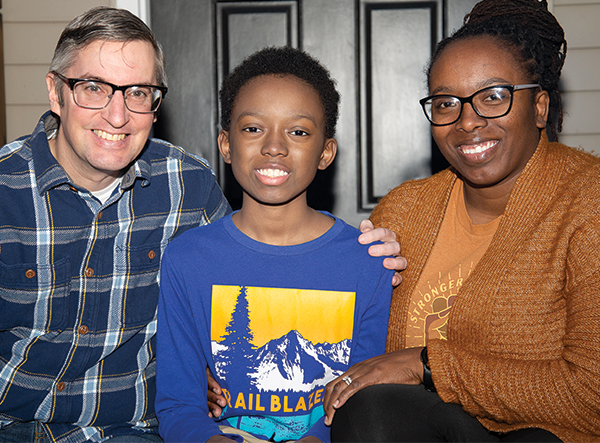 In spring 2022, Donte, then 11, was experiencing recurring fevers, body aches, and a general sense of fatigue. “Our first thought was maybe he had COVID, but he tested negative,” recalls his stepdad, Rich Ward. Urine tests, X-rays, and preliminary bloodwork would follow. But again, no red flags. Still, Donte’s mom, Moya Williamson, had an intuition that this was more than a cold or flu. “I felt it in my gut that something was really wrong with my child’s body.”
It turns out, she was right.
One day, when the family was visiting friends, Donte’s walking became so labored and unsteady that he had to be helped to the car. “And five minutes into the ride home, he was asleep,” his mom remembers. “It was just strange. We couldn’t make sense of it.”
Fortunately, the staff at Hasbro Children’s Hospital’s Tomorrow Fund Clinic would soon put the puzzle pieces together. Advanced blood screening found Donte’s platelet level was low, so a bone marrow aspiration was performed by Rishi R. Lulla, MD, MS, Division Director, Pediatric Hematology/Oncology at Hasbro Children’s Hospital. It revealed the devastating news that Donte
had acute lymphoblastic leukemia (ALL).
Dr. Lulla explained the diagnosis to the family and presented treatment options, which included participation in a well-established ALL clinical trial. After careful deliberation, the family agreed.
Jennifer Welch, MD, is Donte’s hematologist-oncologist. As is protocol for ALL patients, Dr. Welch had an additional diagnostic evaluation conducted after Donte’s initial diagnosis. It unearthed more troubling news. “Within two weeks, we discovered Donte had what’s called Philadelphia Chromosome positive acute lymphoblastic leukemia (Ph+ALL),” Dr. Welch explains. “This is a rare, aggressive subtype of ALL and can be difficult to treat.”
Targeted agents that specifically combat this genetic mutation would need to be added to Donte’s protocol of standard chemotherapy and administered in rigorous adherence to a complex timing and sequencing schedule. He had an aggressive form of cancer, and his course of treatment would also have to be aggressive to defeat it. The family had a long, difficult road in front of them. But together, they stepped up to meet the challenge. “The first thing we did was move all our stuff into the hospital,” Rich now jokes. “Hasbro Children’s became our second home.”
As fate would have it, Rich knew all too well what Donte would be going through. In 1984, he, as a seven-year-old, was diagnosed with Rhabdomyosarcoma, a rare soft tissue cancer that typically affects children and teens. Rich received successful treatment at the Potter Building on the campus of Rhode Island Hospital under the care of Edwin Forman, MD. A trailblazing pediatric healthcare provider, Dr. Forman would later become Chief of Pediatric Hematology and Oncology at Hasbro Children’s when it opened its doors in 1994.
Dr. Forman was also an early mentor to Dr. Welch, who says Rich’s experience “has been invaluable as far as informing Moya on aspects of cancer care and showing Donte what life after childhood cancer can look like.” Rich could also relate on an intimate level when Donte had to deal with lumbar punctures, hair loss, nausea, and so many other scary things and setbacks along the way.
These days, Donte is progressing according to plan and will complete his chemotherapy this summer. After that, he will maintain ongoing visits for assessment and medical management purposes and eventually graduate into Hasbro Children’s survivorship program. Reflecting on Donte’s journey, Moya says, “Our son’s diagnosis was pretty much living our worse fear. But having the Hasbro Children’s team by our side was such a blessing. We will forever be grateful for the dedication and care they extended to our family.”
More than that, Donte says his remarkable patient experience has inspired him to pursue a career in pediatric cancer care when he grows up. “I’m going to be a doctor so I can help other kids facing a similar battle,” he says. “And I’m going to work at Hasbro Children’s Hospital—because that place is the best!”