The Miriam Hospital Traditions 2026
A publication for the friends and supporters of The Miriam Hospital.
Taking Care of Biz: A Grateful Patient Shares His Story
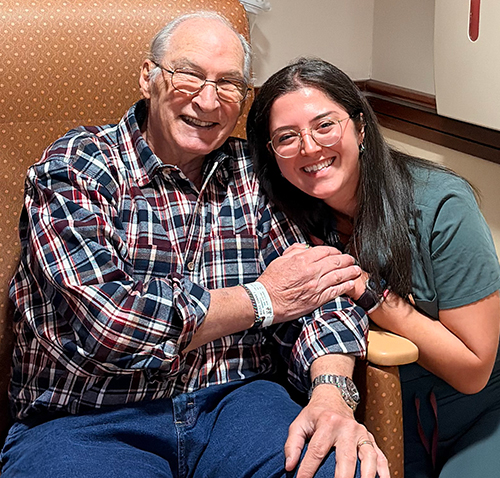 At 77 years old, Connie Elvis Bizzle is still the kind of guy who likes to keep busy, engage in playful ribbing, and lend a hand when he can. A proud U.S. Navy veteran, “Biz,” as he’s known to friends and family, has spent a lot of his time in retirement helping others. Most recently, volunteering at his local church.
But when even setting up chairs for Sunday service left him exhausted and gasping for air, Biz knew something was wrong. “I couldn’t catch my breath,” he recalls, “and I was falling asleep all the time at home, too.”
He visited his primary care physician to look into his chronic fatigue, and on what Biz describes as “a hunch” his PCP ordered a specialized test to measure the level of carcinoembryonic antigen (CEA) in his blood. Although CEA tests are not used to screen for or diagnose cancer, they can be useful because they measure a protein which, when present at elevated levels, can indicate certain malignancies.
(Pictured: Biz sharing a happy moment with infusion nurse Jenna LaValley, one of the many capable and compassionate members of his care team.)
Concerning test results
Biz’s test results were very high and very concerning. His PCP quickly referred him to the Brown University Health Cancer Institute for more extensive screening and evaluation. What followed there was life changing. Bloodwork, scans, and an endoscopy revealed that Biz had stage 4 esophageal cancer, which had spread to his stomach, liver, and lungs.
“When they showed me the PET scan, it looked like fireworks went off,” Biz says. “The bright, glowing hotspots were everywhere.”
 The diagnosis was scary and the outlook was grim. Surgery was not an option because the disease had metastasized. But Biz wasn’t ready to give up—and neither was his care team at The Miriam Hospital.
Howard Safran, MD, Division Director of Hematology/Oncology at the Brown University Cancer Institute, led Biz’s care team at The Miriam.
Creating the ‘best’ plan
“We had his tumor worked up pathologically and conducted precise, specialized testing to understand Biz’s cancer,” Dr. Safran explains. “This detailed, comprehensive analysis helped us identify what therapies would work best and guided our treatment plan.”
Dr. Safran determined that a combination of chemotherapy, immunotherapy, and a targeted drug called trastuzumab, which blocks the HER2 gene pathway that promotes his cancer cells, was the best course of action for Biz.
It was an aggressive regimen. In fact, Biz admits the first 12 chemo sessions were grueling—six hours at a time, every other week. “Those were the toughest days,” he says.
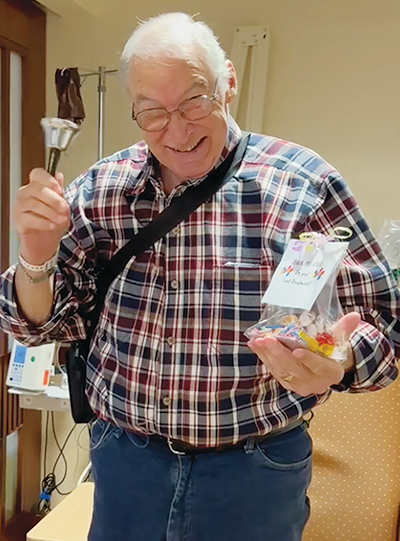
But he kept going. For two years, The Miriam team stood by him, adjusting treatments, managing complications, and offering reassurance every step of the way. Finally, on November 13, 2025, Biz rang the bell at The Miriam signifying his disease was
in remission.
“When someone presents with cancer that has metastasized like Biz’s had, their prospects for long-term survival are not very bright,” Dr. Safran concedes. “Only 1 in 200 go into remission. So, I think Biz is a mini miracle. We had good medicine and good luck.”
Today, Biz’s health continues to improve, although he still faces challenges—neuropathy, hearing loss, and some lingering fatigue. But he’s alive and that’s the most important thing.
A new lease on life
“I’m blessed, just blessed,” he reiterates. “To come out on the other side and hear your scans are clean . . . you can’t ask for more than that. I’m so grateful
to The Miriam for saving my life.”
His wife Sharron agrees: “We always left The Miriam thinking, ‘Whatever they could do for us, they did.’ We felt safe. Everyone treated us like family.”
From the valet to the volunteers, from the nurses to the doctors, Biz says he’ll never forget the people who gave him hope when hope seemed impossible.
“I want The Miriam to get a much bigger bell to ring,” Biz jokes, reflecting back on everything. “One you could hear all over the neighborhood so everyone would hear about the good work they do and the lives they save.”
 When it Comes to Gratitude, Sharing is Caring
The Miriam Hospital often hears from patients, like Biz, who express their gratitude for the care they’ve received. Some send letters and share their stories, others make donations. No matter how it arrives, sharing appreciation creates the positive power to heal, to inspire,
and to connect people in deeply profound ways.
Our “with Gratitude” program aims to keep this energy going and make it easier for people to express their feelings about The Miriam Hospital. To read some of The Miriam’s grateful patient stories—and share your own or show support—please visit: brownhealth.org/TMH-gratitude