Rhode Island Hospital Breakthroughs Banner

Rhode Island Hospital Breakthroughs 2026 

A publication for the friends and supporters of Rhode Island Hospital.


From Collapse to Comeback: 
A Grateful Patient Shares His Story

It was August of 2024, and Marylanders Marc and Cathy Barclay were enjoying a weekend in Newport, Rhode Island. The couple was visiting “The City by the Sea” to attend a wedding shower with their future daughter-in-law’s family, who are from the Ocean State.

Early on the Sunday morning of their stay, Marc made his way downstairs—then fell to the floor. “My right leg just went out from under me,” he remembers. “It was numb 
and, for the life of me, I just couldn’t get up.”

Marc called out to Cathy for assistance. “He felt clammy when I reached out to him,” she recalls, “so I immediately thought maybe Marc was experiencing a cardiac issue.” 
It was quickly apparent to her that something was seriously wrong and that Marc needed medical attention. Cathy called 911 and an ambulance took him to nearby Newport Hospital.
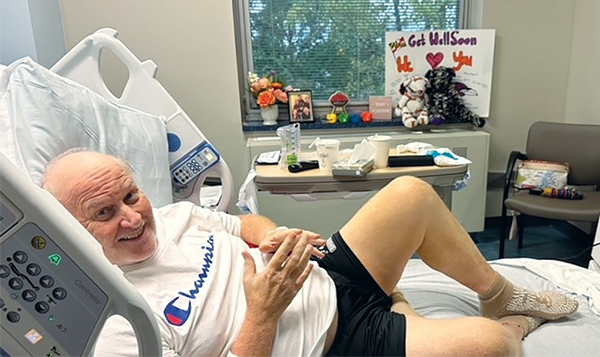
Marc Barclay lies in hospital bed recovering from procedureThe battery of tests administered there initially did not reveal any serious abnormalities. But when Marc’s ER doctor ordered a CAT scan, a potentially lethal complication was unearthed: he had an ascending aortic aneurysm with complete dissection.

In simple terms, the inner layer of Marc’s aorta—the body’s largest artery, responsible for carrying blood from the heart to the rest of the body—had torn apart. Blood flow was being dangerously redirected, depriving vital organs and extremities of oxygen, thus explaining Marc’s inability to move his leg.

A race against time

Without immediate intervention, Marc’s survival was unlikely. He was quickly transferred to Rhode Island Hospital to undergo emergency surgery. The clock
was ticking.

“The risk of dying increases by two percent every hour surgical repair is delayed,” explains Mark Cunningham, MD, Chief of Cardiovascular Surgery, Rhode Island Hospital.

“The overall mortality for patients who experience 
this is about 70 percent. So, it’s a serious, life-
threatening condition.”

More so, Marc’s case was especially complex. The dissection extended into the vessels supplying his brain, leaving him at risk of stroke. Blood flow to his right leg was totally compromised and his aorta—best described as fragile as tissue paper—could not be clamped safely. To operate, Dr. Cunningham employed one of the most advanced techniques in aortic surgery: deep hypothermic circulatory arrest (DHCA).

In DHCA, the patient’s body is cooled to very low temperatures—in Marc’s case, approximately 60 degrees Fahrenheit—and the heart-lung machine is turned off. 
At these very low temperatures, the brain and vital organs can survive without blood flow, but only for a short time.

Working quickly in this motionless, bloodless field, 
Dr. Cunningham replaced Marc’s damaged aorta with a synthetic Dacron graft and reconstructed his blood flow—
to his brain, to his heart, to his leg—one vessel at a time.


“It was very complicated,” Dr. Cunningham explains. “We essentially rebuilt the blood supply to every critical organ the dissection had destroyed.”

The procedure lasted more than 15 hours, and a second surgery followed days later to finetune the repair and close the chest. Marc would spend three weeks in the cardiothoracic intensive care unit, followed by a week in the step-down unit and then additional weeks of acute rehabilitation.

For much of that early time, he remembers nothing. “After my fall, I don’t remember much,” Marc admits. “Just waking up in the hospital three weeks later and asking Cathy, ‘What the heck happened?’”

“The HECK happened alright!” Cathy now recounts, with a wry, weary smile. “His discharge summary was a mile long.”
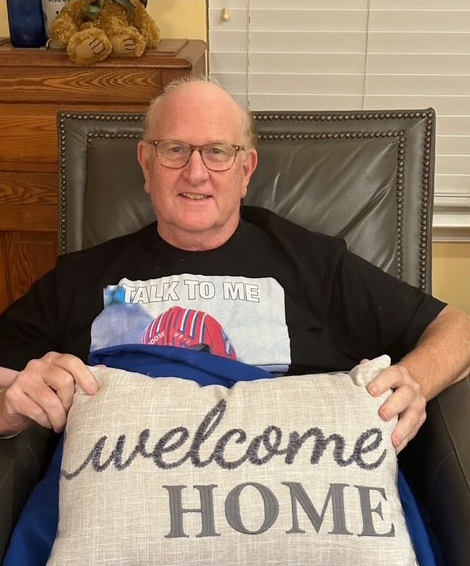
Older man sitting in a chair holding a Welcome Home pillowAttitude and gratitude

One thing Marc does remember well was the goal that motivated him in his rehabilitation that continued once he returned home to Maryland in October of 2024. Marc and Cathy’s son, Alex, was getting married in December and he was determined to walk down the aisle—without relying on a cane.

“That gave him focus and purpose,” Cathy says, “and he put in the work every single day.” On December 7, 2024, Marc fulfilled that promise, proudly walking alongside his wife as Alex and his bride Abby were wed.

Today, Marc is back to work part time at Home Depot and enjoying his full, active life with Cathy and his children, which also include sons Aaron and Adam. His harrowing healthcare journey behind him, Marc is now focused on looking forward.

“Life is good,” he simply states.

Life is indeed good, thanks to the staff at Rhode Island Hospital!

Meet Laura A. Scrimgeour, MD

Surgical Director of Structural Heart Disease 
Cardiovascular Institute at Brown University Health

Laura A. Scrimgeour, MD photoLaura A. Scrimgeour, MD, earned a medical degree from the University of Colorado School of Medicine and completed her general surgery internship, residency, and chief residency at Rhode Island Hospital. After pursuing advanced training in cardiothoracic surgery at the University of California, San Francisco, she was selected for a highly competitive structural heart fellowship at Brigham and Women’s Hospital/Harvard Medical School. Now back at Rhode Island Hospital, Dr. Scrimgeour shares her thoughts on her new role, approach to patient care, and the power of philanthropy.

What motivated you to join the Brown University Health team?

The opportunity to build and grow cardiothoracic surgery within an integrated academic health system like Brown University Health was deeply compelling. Brown Health combines a strong clinical foundation with academic ambition and community impact — an ideal environment to elevate care. Furthermore, I trained here for general surgery and loved living in Rhode Island. So, it was a wonderful opportunity to come back!

How is it going so far?

It has been energizing. I’ve been struck by the talent and dedication of the teams across the system and by a shared commitment to excellence and collaboration. The nursing staff is excellent, the Advanced Practice Provider team is incredible, and my colleagues are extraordinary. There is tremendous opportunity here.

Tell us about your work.

I provide clinical care in cardiothoracic surgery (in the operating room, clinic, and ICU), mentor residents and medical students, and help advance our academic and research endeavors.

My clinical focus centers on coronary artery bypass grafting and structural heart disease. I am particularly committed to delivering durable, evidence-based surgical revascularization as a way to restore blood flow to areas of the heart that aren’t getting enough blood to meet their needs. Advancing multidisciplinary approaches to complex valve and structural heart conditions is another area of focus for me. Academically, my interests include surgical outcomes, quality improvement, and innovation that improves both short- and long-term results for patients with cardiac disease.

Advancing pathways for women and underrepresented groups in cardiothoracic surgery has been a priority of yours. Will it continue here?

Absolutely. Excellence in patient care and innovation requires drawing from the full breadth of available talent. 
At Brown Health we will focus on strengthening the pipeline through early exposure and mentorship, intentionally sponsoring emerging leaders for advancement, and fostering an inclusive culture where all surgeons have equitable access to opportunity and leadership. This work is central to our mission. By investing in people, we are strengthening the future of our field and the care we provide to our patients.

What impact does philanthropy have on supporting your work and the hospitals more broadly?

Philanthropy accelerates progress. It enables innovation, supports research and trainee development, enhances patient programs, and allows us to move more quickly and creatively than traditional funding alone would permit. Funding research to provide the most cutting-edge technology to our patients here in Rhode Island depends upon philanthropy to thrive.

Four Women, One Cause: Going the 
Extra Mile to Find a Cure

Mandi Razza, Michelle Robertson, and Reid Losee met when their respective husbands were bravely fighting glioblastoma, an aggressive type of brain cancer that is resistant to treatment. Melissa Shein was also part of this courageous group of women, faithfully providing support for her brother, Robert, and sister-in-law, Reid.

Four women present check to two doctors at the cancer institute

Sadly, all three men passed away within months of each other in 2023, leaving a massive hole in the hearts of their beloved family members.

Joe Razza was the Chief of Police in Johnston, Rhode Island, the town he grew up in and served the community for 25 years. Alex Robertson was an accomplished orthopedic spine surgeon at the height of his career, and Michelle worked alongside him at University Orthopedics. Robert Shein spoke fluent Russian, German, Arabic, Spanish, and French, and served as a linguist and analyst in the United States Army before running the Language Lab at Rhode Island College for 25 years.

Despite their tragic losses, these women found a measure of triumph by banding together to fight back against this dreadful malignancy.

Eric T. Wong, MD, Director of Medical Neuro-Oncology at the Brown University Health Cancer Institute, had provided care to each of the men along their journey. The women reached out to Dr. Wong to express their gratitude for the exceptional care and kindness he provided but also asked how they might thank him for his efforts and help others.

Dr. Wong suggested they could help by picking up a paused fundraising effort for research on brain tumors, which had been led by one of his patients and his wife from Massachusetts. The women agreed—and on November 8, 2025, they spearheaded their second annual A Reason to Run & Walk event in Johnston. About 170 people participated and raised nearly $43,000 in support of critical brain cancer research at Rhode Island Hospital—surpassing last year’s total of almost $30,000.

“Breast cancer and other cancers have a lot of support groups and fundraising, but brain cancer does not,” Reid points out. “It is lonely and devastating and takes away the very essence of loved ones. The community connected at this event understands and supports each other in a very special and personal way.”

two participants walking on course for A Reason to Run“A Reason to Run & Walk brings happiness and togetherness for an afternoon,” Melissa adds. “Everyone who showed up wanted to lend a helping hand—setting up tables, sorting shirts, placing flags and markers, cleaning up...anything!”

Dr. Wong heralds everyone’s efforts and generosity. “Research is critical, because that’s the place we can make initial observations on how tumor cells grow and, potentially, discover treatments to stop them. These are potentially groundbreaking, high-reward ideas we are studying, and the funds raised at this event help advance our important work. We are grateful and thankful for 
the support.”

Leave a Lasting Legacy

grandmother smiling down at two grandchildrenIncluding Rhode Island Hospital in your estate plans with a bequest is a meaningful way to positively impact future generations of our patients and their families. The hospital was founded in 1863 thanks to a bequest, and these special gifts continue to allow our caregivers to provide the very best in care to everyone in our community.

With the help of an attorney, you can add a bequest to the hospital in your will or trust. You can also name us as a beneficiary of a 401(k), IRA, life insurance policy, or donor advised fund, and this can often be done in a matter of minutes by contacting the financial institution holding your account. No matter how you choose to remember Rhode Island Hospital, a gift of any amount will be greatly appreciated and can be directed to support a specific area or the greatest needs of the hospital.

For more information visit us at brownhealth.org/RIHLegacy or contact Chris Josephson, Senior Philanthropy Officer, at 401-444-6412 or email chris.josephson@brownhealth.org.