Rhode Island Hospital Breakthroughs 2024
A publication for the friends and supporters of Rhode Island Hospital.
Tenacity, Teamwork, and Triumph:
A Grateful Patient’s Remarkable Journey
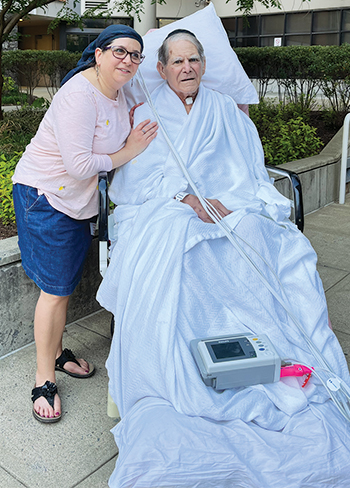 On January 18, 2023, Allan Shapiro collapsed while helping his wife Marilyn bring groceries in from the car. “I didn’t feel quite right after the fall and knew something was wrong,” he recalls. “So, my granddaughter, Chana, took me to the emergency department at The Miriam Hospital, which is about a half a block away from where
we live.”
On January 18, 2023, Allan Shapiro collapsed while helping his wife Marilyn bring groceries in from the car. “I didn’t feel quite right after the fall and knew something was wrong,” he recalls. “So, my granddaughter, Chana, took me to the emergency department at The Miriam Hospital, which is about a half a block away from where
we live.”
At the time, the 81-year-old would have no way of knowing that the accident was the first step in what would become a months-long fight for survival.
“As soon as we arrived at the emergency room, I noticed my grandfather was really having difficulty breathing and his fingertips were blue,” Chana explains.
Sometimes, this can be a sign of heart failure, and tests quickly confirmed Allan had had a heart attack. It was likely a massive silent one and occurred maybe a week or more earlier. Even more concerning was the discovery of a large hole in the wall separating the two lower chambers of
Allan’s heart.
Allan needed an advanced level of care, and he needed
it quickly.
An intra-aortic balloon pump was inserted in Allan’s heart
at The Miriam to control his blood flow—a measure taken to stabilize him enough for his transfer to Rhode Island Hospital. At this point, Allan’s prospects for a successful outcome were still very much in doubt.
“We had a long discussion with Mr. Shapiro when he
arrived about how complicated his problem was,” says Neel Sodha, MD, Director of Cardiothoracic Intensive Care Unit at Rhode Island Hospital. “Oftentimes when patients have this issue, they die no matter what we do. This meant whatever path we chose would be high risk. But Mr. Shapiro wanted aggressive care and his family was onboard with going down whatever road was necessary.”
The first thing Dr. Sodha and team would do is replace the intra-aortic balloon pump Allan had with a left ventricular assist device (L-VAD), which allowed Allan’s heart to flow more blood to his body and less to the side where the hole had formed. Surprisingly, he survived.
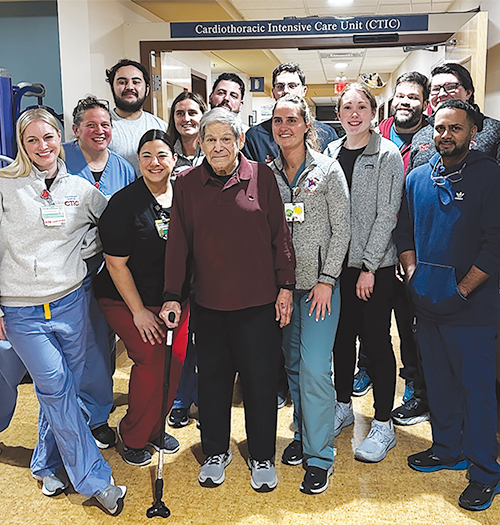 After almost two weeks of stabilization on the L-VAD to minimize the surgical risk, Allan underwent open heart surgery. During the complex procedure, Dr. Sodha and team addressed three separate issues: the blockages in Allan’s arteries, for which they performed a two-vessel coronary artery bypass; the hole or ventricular septal defect separating the two lower chambers, for which they created a series of patches to restore continuity; and the ruptured outside portion of his heart, which they repaired as well.
Post surgery, Allan went back to the cardiothoracic intensive care unit and remained in critical condition for an extended period. “He was about as sick as sick could be,” says Raymond Cord MHP, PA-C, EMT-P, Senior Physician Assistant on the cardiac ICU Team.
His lungs struggled to respond, so he was put on a ventilator. His kidneys failed, and he was started on 24/7 dialysis. He experienced a gastrointestinal bleed that required multiple transfusions. Even the breathing tube that was removed two weeks after surgery had to go back in. During this time, Allan was mostly in a medically induced coma.
“Allan had an indomitable spirit, and he persevered, but struggled to improve,” Raymond remembers. “It was always one step up, two steps back.”
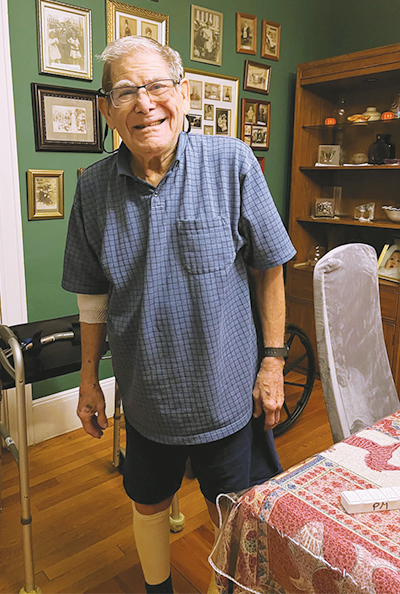 On April 12, 2023, Allan had a temporary tube placed in his neck to aid his breathing. Shortly thereafter, a glimmer of hope emerged. He started to improve and started to work with his therapy teams. Soon, he improved enough to breathe on his own. He worked his way off oxygen and began eating again, too.
Eventually—after 109 days in the hospital—Allan was well enough to be discharged to a skilled nursing facility, where he spent another 100 days.
His determination and perseverance continued to see him through.
Throughout his journey, Allan relied on his loving family, loyal friends, spiritual leadership, and unwavering faith to keep his spirits up, and his dedicated multidisciplinary Brown University Health team to deliver the sophisticated, compassionate care he so desperately needed.
Reflecting back, Allan’s daughter, Marcie Ingber, sums up her father’s experience this way: “At one point, there was less than a five percent chance my dad would survive. But he was determined to live, and his care team did everything in their power to make that happen. They were amazing.”
For staff, the feeling is mutual. “This man is a miracle,” Raymond flatly states. “We are part of his family now and they are part of our family.”